Table Of Content
- The Islamic Arts Biennale Re-Imagines Jeddah’s Western Hajj Terminal as a Cultural Space
- New restaurant is coming to former Pizza Volta space in Sugar House
- Berlin set to build car-free housing and technology district on former Tegel Airport
- MAD Architects Unveils Design for Changchun Airport’s New Feather-Like Terminal in China
- A City Within a City: How Micro-City Design Breathes New Life into
- Passenger terminal layout and design
The recently completed Aile Est terminal, designed by a consortium including British architecture studio RSHP to replace an outdated 1970s facility, is intended to produce more energy than it consumes by using on-site renewable sources such as geothermal piles. New York City is the pinnacle hybrid between the vibrant and granular neighborhoods that Jane Jacobs once envisioned and the sweeping urban innovations of Robert Moses. After the September 11th and Hurricane Sandy tragedies, the delicate balance between promoting a sense of individual culture and the strength in unity that New Yorkers are so often known for served as the lifeblood for revitalization. New York City has consistently handled adversity, by always rethinking, redesigning, and rebuilding this city for a better future.
The Islamic Arts Biennale Re-Imagines Jeddah’s Western Hajj Terminal as a Cultural Space
Mobile lounges used at Dulles International Airport near Washington, D.C., and at Jiddah’s King Abdul Aziz International Airport have bodies that can be raised and lowered to suit the exact height of the terminal floor and the aircraft sill. However, passenger loading and unloading times are lengthened, causing turnaround delays, and aircraft are more likely to be damaged by the heavy lounges. For such reasons, this type of design has not proved popular with either passengers or airlines. Airports that receive a large number of transferring and transiting passengers are referred to as hubbing airports.

New restaurant is coming to former Pizza Volta space in Sugar House
These are supplemented by airfield markings, signs and signals, and air traffic control facilities. Support facilities on the airside of the field include meteorology, fire and rescue, power and other utilities, aircraft maintenance, and airport maintenance. Landside facilities are the passenger and cargo terminals and the access system, which includes parking, roads, public transport facilities, and loading and unloading areas. Often serving as a city’s first impression, airports combine landscapes, ecologies, air rights, and infrastructure to connect people and place. As new technologies and advancements transform aviation, so too has airport architecture evolved to meet modern travel demands. With an impressive range of scales, programs, and material assemblies, the following projects showcase dynamic and thoughtful aviation spaces.
A New Airport Terminal in Bengaluru Brings Nature Inside - Architectural Record
A New Airport Terminal in Bengaluru Brings Nature Inside.
Posted: Tue, 09 Jan 2024 08:00:00 GMT [source]
Berlin set to build car-free housing and technology district on former Tegel Airport
PIT CEO: It's Time to Have Pittsburgh's Airport Designed for Us - Blue Sky News
PIT CEO: It's Time to Have Pittsburgh's Airport Designed for Us.
Posted: Mon, 13 Nov 2023 08:00:00 GMT [source]
The TBIT construction was carried out by a joint venture of Clark Construction Group and McCarthy Building Companies. O’Connor Construction Management provided various services, such as cost estimating and phasing studies. LAX’s Cargo Modernisation Program aims to enhance cargo facilities and capabilities at LAX, enabling the city of Los Angeles and the broader Southern California region to bolster economic vitality through improved technical advancements and efficiency. The four lounges feature new amenities and furnishings, which replaced 16 individual lounges and expanded the terminal’s overall lounge space to 46,972ft² (an increase of 72%).
Los Angeles International Airport Modernisation, US
In November 2008, a new plan was developed focusing on rebuilding and renovating existing terminals, giving priority to accommodate new larger aircraft and increase security. MCIA is the second largest airport in the Philippines and to meet the demand of increasing traffic, the modular design of the airport can adapt to the future expansions of the structure. It conceptualized reflecting the resort-like feel but functioning as an airport terminal. The high pitched roof and eaves being at the lower level eliminate maximum heat gain and glare during the day.
Through their signature holistic design approach, CallisonRTKL has successfully created an airport that is of the region, the city and the community at large. Unique to CRTKL, holistic design is a hyperactive design process where all stakeholders come to the table during day one of planning. The traditional design approach encompasses one conceptual design plan that is then presented to the technical architects and consultants; mechanical, electrical, and plumbing (MEP); and stakeholders to ultimately agree or disagree with the plan. With holistic design, you have all the aforementioned parties involved at the table from the very beginning to collectively decide what direction to take with the entire airport’s design.
It has become a highly collaborative process, designers and operators working with a host of specialists to create a building that covers all the bases – attractive, practical, calming and seamless. Segregation of passenger flow, which became a major issue after the Schengen Agreement, meant the removal of border controls for some European countries is another development that has had as much of an influence on passenger movement as heightened security. Click here to read the Chinese version of this article on Dezeen's official WeChat account, where we publish daily architecture and design news and projects in Simplified Chinese. Completed in 2019, the starfish-shaped Beijing Daxing International Airport designed by the late Zaha Hadid along with specialist firm ADPI is one of the largest in the world at 700,000 square metres.
Collcoll hides stairs and seats in pixellated wooden structure at Pricefx office
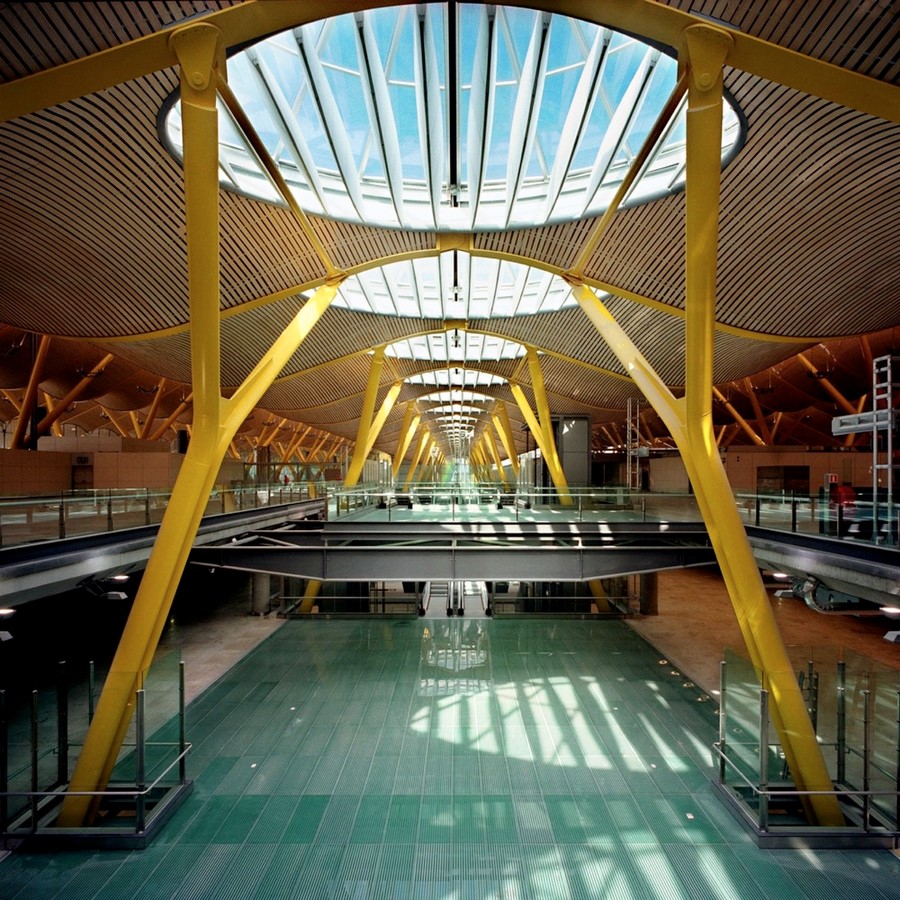
The NAT (T4) at the International Madrid-Barajas Airport is located three kilometers north of the old Barajas terminals TI, T2 and T3. The original design concept has been maintained in the final building and replies to the complex and extensive requirements of the specification, organizing activity within three buildings. The Terminal Building is characterized by three lineal modules (Check-in spine, processing spine, Pier), and serves different functions according to the passengers flow. The 32-year-old terminal is equipped with state-of-the-art technology, including automated checked baggage inspection and sorting system, consolidated security screening checkpoint, and renovated arrivals/baggage claim unit. Airside improvements include runway safety area improvements at all four runways, creation of Taxilane S, $333m south airfield improvement, $138m crossfield taxiway, and $13.5m LAFD aircraft rescue and fire-fighting station.
The vaulted ceiling design of the airport gives a strong impression of directionality from airside to landside in intuitive wayfinding thus enhancing the passenger experience. The interiors are inspired by the ever-changing hues and tones of Istanbul whereas the subtle slatted roof demonstrates the play of natural light in a range of blue colours and intricate geometric patterns. A massive airport in its final phase by the year 2025, is estimated to handle up to 200 million passengers becoming the biggest airport worldwide under a single roof in terms of passenger traffic.
The heart of the structure houses the world-s largest indoor waterfall ‘rain vortex” that cools the accompanied forest valley garden equipped with over 200 species of flora and fauna that has become a jewel in itself. It was not until the general introduction of heavy monoplanes for transport, such as the Douglas DC-3, during the late 1930s that extensive takeoff and landing distances were needed. Even then, the prewar airfields at New York City (La Guardia), London (Croydon), Paris (Le Bourget), and Berlin (Tempelhof) were laid out on sites close to the city centres. Because even transport aircraft of the period were relatively light, paved runways were a rarity.
The new TBIT boasts 18 new gates, a Great Hall for dining and shopping, new immigration screening area, expanded federal passenger security screening area, and airline lounges. The rental car facility consolidates all on-airport rental car operations for LAX for the convenience of passengers and to improve efficiency of the car rental companies. The new facility was planned to be connected via the new APM to the CTA and ITC to alleviate the traffic impacts of multiple shuttle buses. On the south runway system, the southernmost runway (runway 25L) was moved 50ft south to accommodate a new central taxiway, improving airfield safety. The $89m central taxiway project commenced in April 2007 and was completed in June 2008. The project includes a new Headhouse, Delta Sky Club, and reconstructed Terminal 3 concourse, enhancing security screening capacity.


No comments:
Post a Comment