Table of Content
However, as the fridge is generally left turned on around the clock, it’s often the appliances that draw the most energy from the grid. Most of the electricity used in your home will be consumed by your appliances. Some of these appliances are surprisingly energy hungry, even when they’re on standby. Average household gas consumption per meter was 28 per cent lower in 2020 than in 2005. If you run a 6-ton AC for 8 hours, you will use anywhere from 23.0 kWh to 41.4 kWh of electricity. If you run a 5-ton AC for 8 hours, you will use anywhere from 19.2 kWh to 34.3 kWh of electricity.
So it definitely makes sense to get the most energy-efficient model. Electricity use varies greatly depending on size – and just so you know, it’s cheaper to run a fridge-freezer than two separate appliances. Understanding when we use electricity and what we use it for, can be really helpful when you’re trying to be more energy-efficient. But what you may not yet know is that some appliances, like a TV or laptop, still use electricity, even when they’re on standby. Well, with temperatures regularly rising above 40 degrees, you can bet most of that electricity goes on air-conditioning.
Does unplugging appliances save energy?
Alternatively, if you’ve got several household members you can connect two DELTA pro units to generate an astonishing 7200W output. If the median watt-hours of a home per day is 30,000, to find out how many kilowatts it takes to run a house using direct calculations, simply divide the wattage by 1000 to get 30. Next, we’ll calculate the average wattage for a house per day by using the median number of kWh per day.

Average energy consumption varies dramatically between households. Large, poorly-insulated homes, and those that are jam-packed with tech, are likely to use considerably more electricity than small, well-insulated properties. According to government figures, the average household in the UK consumes 3760 kWh per year. This figure has dropped over the last few years, dipping below 4,000kWh for the first time in decades in 2014.
Also in Energy and the environment explained
So, to continue our example of calculating the number of solar panels required for 1000kWh, divide 6203 by the solar panel power output . Home-mounted solar panels normally have individual power ratings from 175 watts to 400 watts. Domestic solar panels can have power ratings anywhere from 200 watts to 350 watts.

You’re not alone if you’re confused with all Texas energy companies and electricity plans. Here in Texas, the most significant impact you’ll see on your usage comes from heating and cooling. Guide to electricity rates and plans for more information. A standard clothes dryer consumes around 550 kWh per year, assuming it’s used for three loads of laundry per week in line with how much average homeowners use their washing machines. This assumes that it’s run about once every other day, which is the common usage for a family of four. Hawaiians used the least amount of energy in 2020 at just 6,446 kWh, while homeowners in Louisiana consumed more than double that amount at 14,407 kWh.
Also in Units and calculators explained
This amount of electricity also assumes you use your fan 24 hours a day, seven days a week, which won’t necessarily be the case in all parts of the country. If you live in the southern states and are comfortable relying on just a ceiling fan, this number could be accurate. Lastly, the size of the ceiling fan matters, with larger fans consuming slightly more energy per hour running than smaller ones.
The difference between kWh and kW, and what you see on your bill, is that kW reflects the rate of electricity you use, and kWh indicates the amount of electricity you use. A 5-bed home can be considered a high consumption household due to the fact it is larger than the vast majority of homes. Using the Typical Domestic Consumption Values for a high consumption household, on average you would be expected to get through around 4,300 kWh of electricity. The answer to the question of which household appliances use the most power is heating and cooling, and top of the list is your HVAC system. U.S. home uses around 1,000 kWh of energy per month or about 32 kWh per day. The average UK household uses around 8.5 – 10 kWh electricity and kWh gas per day.
How Much Electricity (kWh) Do Air Conditioners Use? (Calc + Chart)
Realistically, you need around 40 panels of the same power rating to produce a 1000kWh solar system. If you multiply the price of one solar panel by the number of panels you will use, you will get the total cost of the solar system. Location plays the most crucial part in affecting the power generated by your solar panels.

These statistics aren’t super up-to-date, with the latest Energy Information Administration stats only updated in 2015 when it comes to home sizes. But it has some other interesting comparisons too on things like the number of people living in a home, or annual income. And because these devices normally work on systems that control your whole home, the size of the property also matters. It takes less power to air condition a 2,000-square-foot home than it does a 3,000-square-foot home. But if the above knowledge from this article is put to use, it would go a long way and help you minimize spending on energy bills. How Much Electricity Do You Save By Unplugging Appliances?
1 kWh would be used to run a 1000-watt appliance for an hour . Or on a smaller scale, a 100-watt lightbulb would run for 10 hours using 1 kWh. The easiest way to work out how many kilowatt-hours per day you’re using is to check your smart meter, if you have one. The average residential cost of electricity in British Columbia is $0.126 per kWh, or $126 per month, assuming an average monthly usage of 1,000 kWh. This is up from $0.124 per kWh, or $124 per month in 2020. We used the tiered residential rates from BC Hydro and Fortis BC to calculate prices in BC.
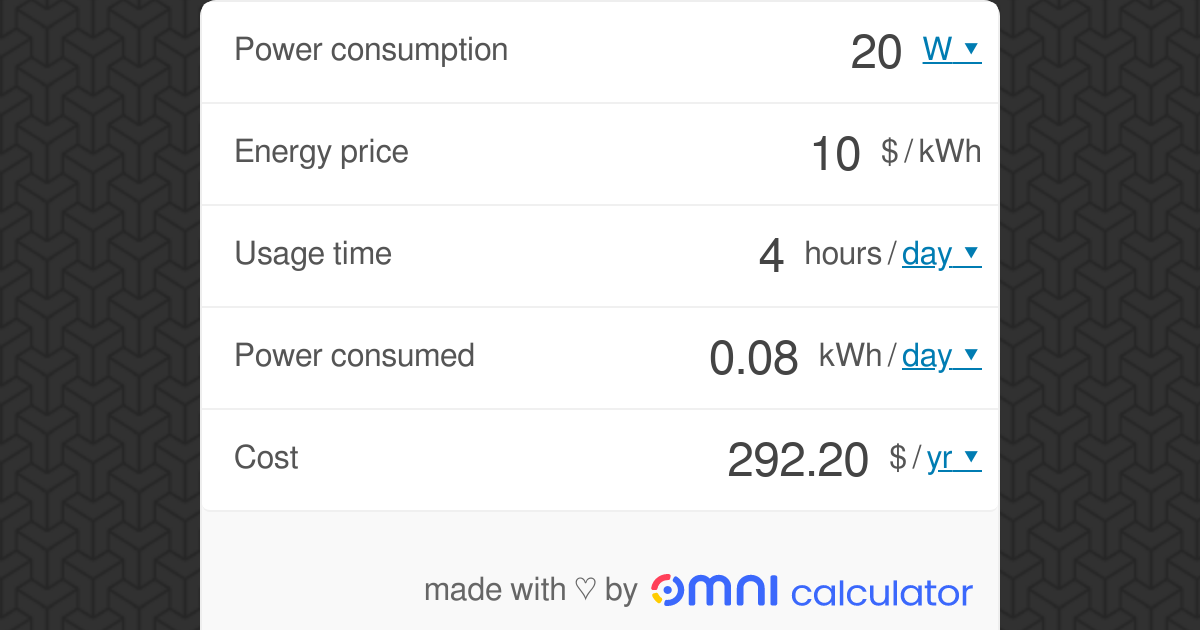
Even things like electricity habits — like leaving lights on — and home age can affect energy consumption and energy efficiency. You can check your past energy bills to see how much electricity you consume throughout the year. An average central ac will use 3000 to 5000 watts of power for around 9 hours a day during the hotter months. Click calculate to find the energy consumption of a central air conditioner using 3500 Watts for 3 hours a day @ $0.10 per kWh.
The table below lists the top household items in terms of total energy used per year. The average American house uses a specific range of energy each month. A way to decrease your energy usage is to limit the time you use appliances, and use set timers for automatic shutoff. Yes, a 10kW solar panel system can cover the typical American household’s annual power use of 10,715 kWh.

According to the EIA, in 2017, the average annual electricity consumption for a U.S. residential home customer was 10,399 kilowatt hours , an average of 867 kWh per month. That means the average household electricity consumption kWh per day is 28.9 kWh (867 kWh / 30 days). This can also help you identify where you can conserve and reduce electricity usage, ultimately making your home more energy-efficient. Below, we’ll discuss how much energy the average household uses and how much electricity common household items consume.


No comments:
Post a Comment